UBT Contributes to Kosovo’s Vision 2050 for Smart Cities, Urban Planning, and Sustainable Development
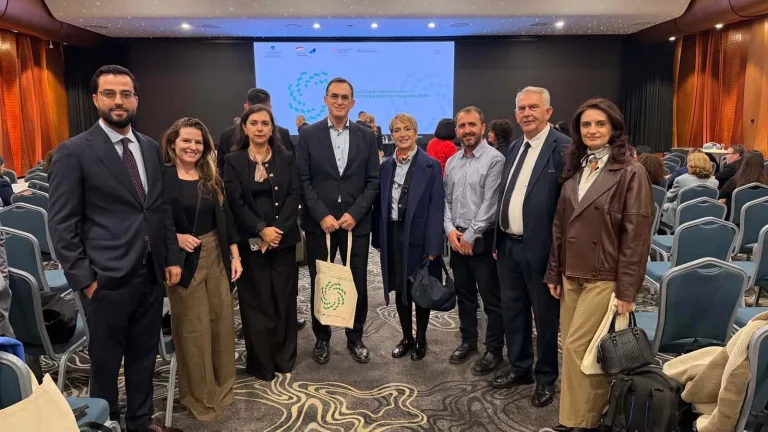
16/10/2026The Rector of UBT, Prof. Dr. Edmond Hajrizi, together with the institution’s academic staff, is participating in the International Symposium “Kosovo’s Spatial Vision 2050,” held in Prishtina, bringing together architects, urban planners, and experts from Kosovo and around the world.
Organized by the Ministry of Environment and Spatial Planning, with the support of GIZ, the symposium provides an important platform for discussing the future of spatial planning in Kosovo, environmental protection, and the development of more functional, greener, and more sustainable cities and settlements.
With more than 20 years of experience in higher education, scientific research, and innovation, UBT has developed significant academic and professional capacities in architecture, urban planning, and sustainable development, placing knowledge and expertise at the service of Kosovo’s development. In this context, UBT has established the Institute for Planning as an integral part of the institution. The Institute focuses on scientific research, innovation, and development in spatial and urban planning, with the aim of translating academic knowledge and innovative solutions into tangible contributions for the country’s cities, municipalities, and institutions.
A particularly important role in this field is played by the Faculty of Architecture and Spatial Planning, one of Kosovo’s key centers for education and professional expertise in this area. Through its academic programs, scientific research, and international cooperation, UBT contributes to educating professionals and advancing contemporary urban planning practices. Its program in Urban Planning and Sustainable Development, which according to institutional information was the first of its kind in Kosovo, represents an important effort to advance the field nationally.
At the international level, UBT is an institutional member of the Association of European Schools of Planning (AESOP), the International Society of City and Regional Planners (ISOCARP), and the European Association for Architectural Education (EAAE), actively participating in the academic and professional networks of these organizations. Through this engagement, as well as by presenting its model and experience at international conferences, symposia, and forums, UBT contributes to knowledge exchange, the development of innovative ideas, and the connection of local expertise with international practices in architecture and urban planning.
This expertise is complemented by UBT’s work in environmental studies, sustainable infrastructure, construction, agriculture, energy, and technology, creating a broad interdisciplinary foundation for educating future professionals, conducting research, and developing innovative solutions for housing, infrastructure, and urban environments. Through cooperation with public institutions, municipalities, universities, and professional partners in Kosovo and internationally, UBT aims to support a more systematic, integrated, and expertise-based approach to planning and sustainable development.
In this context, UBT Smart City and the 10-minute city model represent an approach designed to bring essential services, public spaces, green areas, and everyday amenities closer to citizens, creating environments that are more accessible, functional, and environmentally friendly. By integrating spatial planning, architecture, digital technology, artificial intelligence, and innovation, this approach seeks to contribute to cities that use resources more efficiently, promote sustainable mobility, and improve quality of life.
In line with its UBT 5S strategic vision, the institution continues to promote a development model in which education, scientific research, and technology are connected to the real needs of society.
UBT’s participation in the International Symposium “Kosovo’s Spatial Vision 2050” reaffirms its commitment to serving as an active partner to Kosovo’s institutions, contributing professional expertise, research, and innovative ideas to planning the country’s future.
For UBT, the cities of the future must be built on the principles of sound planning, environmental sustainability, expanded green spaces, quality infrastructure, and innovation. The goal is to help Kosovo develop smarter, more inclusive, and more livable communities for today and for generations to come.